Good Monday morning!
In today’s edition of Your Daily Phil, we report on the changes coming to the American Jewish University’s Ziegler School of Rabbinical Studies, and spotlight a female-focused, Arab-Jewish olive oil collective in northern Israel. In the latest installment of eJP’s exclusive opinion column, “The 501(C) Suite,” Winnie Sandler Grinspoon writes about the motivation behind the Harold Grinspoon Foundation’s Amber Awards. We also feature an opinion piece by Ruthie Bashan about “adaptive narrowing” in philanthropy and one by Kenneth L. Marcus about utilizing a growing compliance framework to help prevent or respond to incidents of antisemitic violence and
discrimination. Also in this issue: Ran Gvili, Galit Cohen and Lisa Bassewitz.
Spread the word! Invite your friends to sign up.👇 |
|
| -
The Israel Defense Forces announced that it has located the remains of Ran Gvili, a police officer who was killed during the Oct. 7 attacks. “And such, all of the hostages have been returned from the Gaza Strip,” the military says in a statement.
-
Ahead of International Holocaust Remembrance Day tomorrow, Meta, UNESCO and the World Jewish Congress are convening a discussion at the U.N. today in New York focused on the role that technology can play in Holocaust preservation efforts.
-
Also in New York, the Stephen Wise Free Synagogue is hosting a town hall discussion about antisemitism with the congregation’s senior rabbi, Ammi Hirsch, and Anti-Defamation League CEO Jonathan Greenblatt.
-
Israel’s Ministry of Diaspora Affairs is hosting the second annual International Conference on Combating Antisemitism in Jerusalem. Speakers at the two-day confab include Diaspora Affairs Minister Amichai Chikli, Jewish Federations of North America CEO Eric Fingerhut, the Department of Justice’s Leo Terrell, along with a number of representatives from European and South American countries.
-
Elsewhere in Jerusalem, Israeli President Isaac Herzog will host the annual lecture of the Jabotinsky Institute at the President’s Residence tonight, delivered this year by U.S. Ambassador to Israel Mike Huckabee.
-
The Israeli advocacy group Librael, which strives to connect progressive Americans with Israel, and Camera on Campus, the pro-Israel media watchdog’s university arm, are hosting a joint event tonight on U.S.-Israel relations in the wake of the war in Gaza at Reichman University outside of Tel Aviv.
|
|
|
American Jewish University’s Ziegler School of Rabbinical Studies — one of the few rabbinical programs on the West Coast and the only Conservative one — is going to undergo a significant overhaul in the coming months, according to officials at the university. Though what that overhaul will look like remains unclear. That may mean dropping its denominational connection, it may mean a radical reconsideration of its curriculum and pedagogy; it may mean all of those things. But it is not shutting down, Jay Sanderson, AJU’s president, told eJewishPhilanthropy’s
Jay Deitcher.
The rabbinical school’s uncertain future came to light last Wednesday when Sanderson told a gathering of faculty and staff that Ziegler’s longtime dean, Rabbi Bradley Shavit Artson, was leaving his current role — while staying on at the university — and that discussions were underway to reenvision the program. The news was not greeted with overwhelming applause. One person cried; others passionately voiced their opposition. While understanding their concerns, Sanderson was unmoved and unsurprised.
“Nobody in a situation wants change, even if they're not happy,” Sanderson said on Friday. “Everybody would rather be uncomfortable than go through a change process.” Larry Platt, the chair of AJU, told eJP that the board stands behind Sanderson, having hired him because he's a disruptor. “He's doing exactly what the board wants him to,” Platt added.
The overhaul of the Ziegler School comes amid a long-running discussion about the future and purpose of the American rabbinate, a conversation that was supercharged in November, with the release of Atra’s dual study on rabbis and rabbinical students. “Everybody talks about the challenges [of rabbinic schools] over and over again,” Sanderson said. “It's a very complex issue that, honestly, in the nine months I've been here, I've been surprised at how little real, actual transformation is happening in the field.”
Titled “From Calling to Career: Mapping the Current State and Future of Rabbinic Leadership,” the Atra study showed that new rabbis preferred non-pulpit roles over congregational roles, despite lower pay, because pulpit positions were considered far more emotionally taxing with unrealistic expectations. At the same time, new clergy were increasingly being ordained at nondenominational schools, often chosen because of convenience, not ideology.
On a mid-January episode of Jonah Platt’s “Being Jewish” podcast, which was taped in July, Sanderson said he would like to see Ziegler go nondenominational. But when he spoke with eJP Friday, he emphasized that no decisions have been made and it will be a thorough process involving the board and the entire community that will lead to the school’s transformation.
“Institutions like AJU, HUC, JTS and Hebrew College all have very challenging and demanding questions before them,” Steven Windmueller, emeritus professor of Jewish communal service at the Jack H. Skirball Campus of Hebrew Union College-Jewish Institute of Religion in Los Angeles, told eJP. “And those questions include, where do we go from here?”
Read the full report here. |
|
|
Too Israeli for the world, too Arab for Israelis, women’s olive oil collective presses on
|
For two decades, Sindyanna of Galilee built its model on a simple three-step premise: sell high-quality, fair-trade olive oil from Arab Israeli farmers to international markets; funnel profits back into an empowerment collective for Arab women; and prove that commerce could build bridges between Jews and Arabs in the Galilee. By early October 2023, its exports were booming and Jewish Israelis were flocking to its visitors center to learn traditional Galilean cuisine alongside Arab women. Then came Oct. 7, reports Rachel Gutman for eJewishPhilanthropy. After the Hamas terror attacks and the launch of
Israel’s war against the terrorist organization in Gaza, longtime customers from abroad cut ties, not because of quality concerns, but because the products came from Israel, according to Hanan Manadreh Zoabi, co-manager of Sindyanna's Visitors Center. Jewish Israelis’ fear of entering Arab villages, even for an explicitly coexistence-focused program, became insurmountable. The visitors' center sat quiet.
Something extra: But Sindyanna — a self-sustaining organization that runs like a business but functions as an NGO, cycling all profits back into programming — isn't folding. Instead, it’s doubling down on the most challenging path: winning over Jewish Israelis one bottle at a time. "When one person puts our oil on their counter," Nadio Giol, Sindyanna’s co-manager of the visitor center, said, "that is a start." Sindyanna’s team is betting that its optimistic branding will help. Instead of just “extra virgin,” its olive oil is labeled "Extra Positive," "Extra Peaceful" and "Extra Hopeful."
Read the full report here. |
|
|
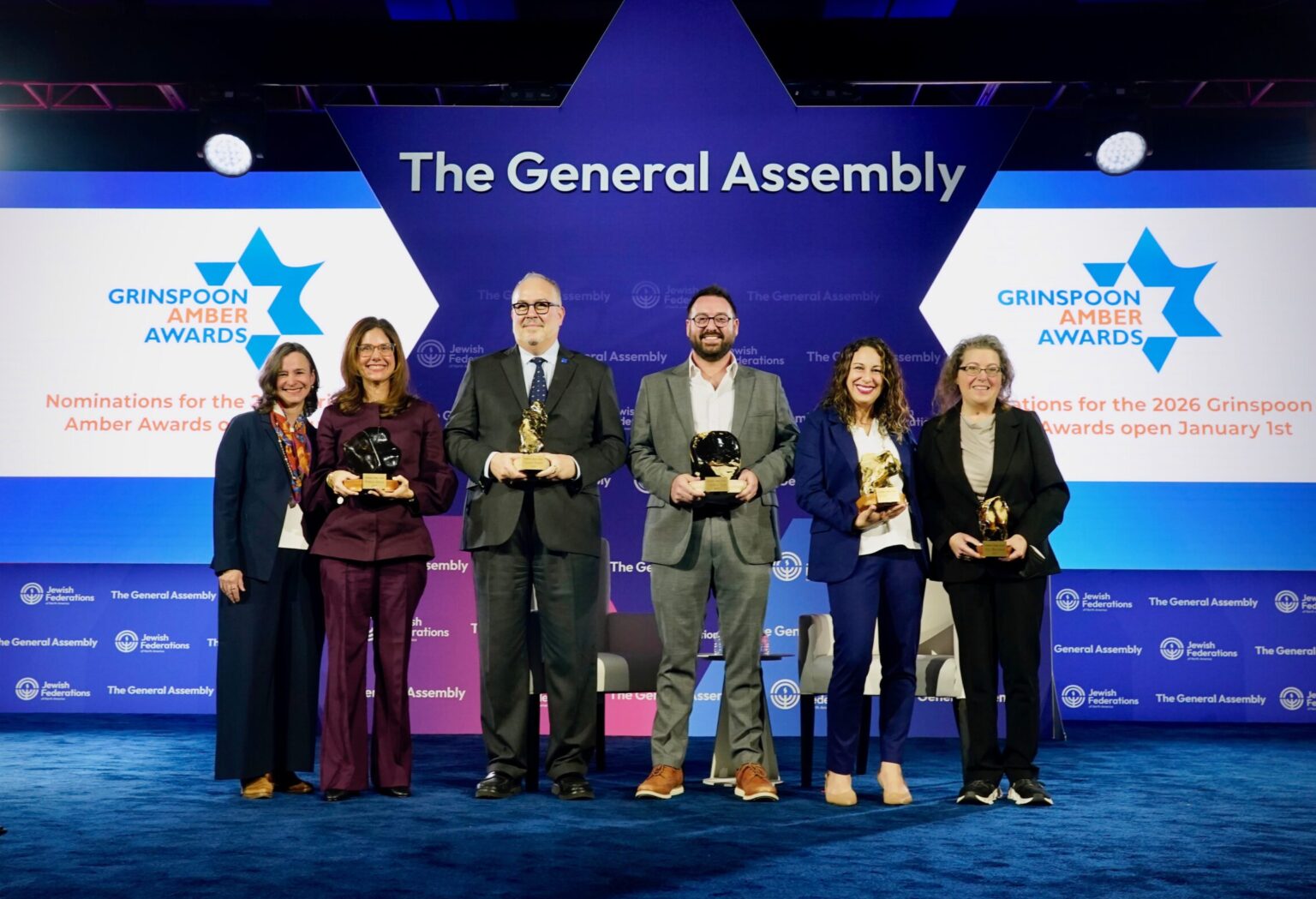
“As any development professional will tell you, nonprofit organizations expend significant efforts to cultivate, thank and recognize our donors. We also take the time and care to recognize, train and uplift our lay leaders, who give their time and expertise to help steer and support our communal organizations to advance their missions,” writes Winnie Sandler Grinspoon, president of the Harold Grinspoon Foundation, in the latest installment of eJewishPhilanthropy’s exclusive opinion column, “The 501(C) Suite.”
Share that spotlight: “What about the Jewish professionals? Are we doing all we should to recognize and thank the people who are devoting their professional careers to the many organizations and projects that sustain and enhance our community? … The [Grinspoon] Amber Awards are important as a cultural shift: a reminder to recognize outstanding leadership at all levels, and honor it in a way that is both personal and public. This award, and everything it symbolizes, exists to remind us to affirm, celebrate and elevate the exceptional professionals whose contributions shape our collective future.”
Read the full piece here. |
|
|
A trauma-informed look at giving and community resilience |
“Urgency. Fatigue. Fragmentation. Slow recovery. Over the last five years, we’ve seen philanthropy in America move through the same cycles that trauma clinicians recognize all too well,” writes Ruthie Bashan, a consultant specializing in trauma-informed care and community resilience, in an opinion piece for eJewishPhilanthropy. “The numbers tell one story — total charitable giving in 2024 reached a record $592.5 billion, rebounding after years of decline — but beneath that is another story: the number of donors continues to shrink, with dollars coming from fewer people through larger gifts while smaller, community-based giving has become more sporadic
and crisis-driven.”
Collective healing: “In trauma work, we call this adaptive narrowing; it’s when systems under stress redirect energy toward survival. Philanthropy is doing something similar now, tending to the wounds that are closest, visible and pressing. … Each new emergency resets the emotional field. Urgency dominates the headlines; long-term engagement quietly fades. But trauma-informed philanthropy invites us to see this differently. It asks, what if our goal isn’t simply to raise more, but to help communities recover their capacity to care? That shift — from extraction to co-regulation, from transaction to relationship — transforms philanthropy into a tool for collective healing.”
Read the full piece here. |
|
|
Antisemitism laws can protect you, but you have to understand them |
“While data published at the close of 2025 suggested that the surge in antisemitism around the world over the past two years has ‘leveled off,’ recent events tell a different story,” writes Kenneth L. Marcus, chairman and CEO of the Louis D. Brandeis Center for Human Rights Under Law, in an opinion piece for eJewishPhilanthropy. “Over the past two decades, antisemitism has shown a steady upward trajectory, despite occasional dips. A plateau at historically high levels is not stability. It is normalization.”
Accountability involves you: “Over the past few months, the Brandeis Center has won major settlements with Pomona College, UC Berkeley, Nysmith School and the Association of Legal Aid Attorneys. Taken together, these settlements mark a turning point. They are no longer isolated resolutions, but a developing compliance framework to help prevent future incidents of antisemitic violence and discrimination. … The infrastructure for enforcement now exists; the remaining question is whether institutions will act proactively, or wait to be compelled. But enforcement is not enough on its own. Societal vigilance must also be rebuilt. … Know your rights under the law. Report incidents, demand institutions meet established standards and hold them accountable. Civil rights advances rarely come from goodwill alone. They come when law, precedent and public insistence converge.”
Read the full piece here. |
|
|
Under Investigation: In the upcoming issue of The New York Review, Aryeh Neier and Gara LaMarche identify the Trump administration’s scrutiny of the Open Society Foundations as a new front in the administration’s attack on civil society. “Trump has called George Soros a ‘bad guy’ who ‘should be put in jail,’ and he recently suggested that prosecutors charge him under the Racketeer Influenced and Corrupt Organizations Act. In September Deputy Attorney General Todd Blanche — one of the president’s former personal lawyers, like a number of his appointees to the Justice Department and the courts — took up his recommendation and instructed
more than six US attorneys’ offices to launch investigations of OSF on possible charges ranging from arson to support of terrorism, for which no evidence has been offered.” [TheNewYorkReview]
Climate Control: In The Times of Israel, Galit Cohen, Israel director of the Jewish Climate Trust, decries the Israeli government’s consideration of leaving the United Nations’ Climate Convention as a threat to national security. “Renewable energy is often framed as an environmental issue. In reality, it is a strategic asset. For Israel, renewable energy is the foundation of energy security, economic resilience, and continuity of essential services in times of crisis. … The climate convention provides the international framework that defines norms, standards, and rules in energy, industry, finance, and
development. Participation in this framework gives Israel access to markets, partnerships, investment, and influence that far outweigh the obligations involved. … Israel has already experienced how close it came to large-scale power outages, and this risk has not disappeared. Preparing for future wars, cyber threats, and climate-related disruptions requires decentralization of the energy system. Such decentralization is impossible without renewable energy and the advanced technologies that accompany it. This is national security in its deepest and most practical sense.” [TOI]
Deus ex Machina: In Arc, Henry Michaelson ponders the inverse relationship between religion and technology. “As I’ve explored my religious commitments — observing Shabbat (albeit a limited Shabbat that involves no digital technology, spending money, or working), praying and attending weekly services, making an active effort to be aware of God during intimate moments with people and in nature, and feeling an answer to the question ‘why?’ when submerging myself in the utter beauty of the small cosmic possibility of every moment I live — I’ve received unexpected lessons that only reinforce my religious cravings. What started as a search for answers about Truth and the universe has become a training in rewiring one of my
most basic functions as a human: relating to others. I can’t say with certainty what drove the turn to religion for me, but I do know that statistics fail to capture the experiential reality of what it means for someone like me to seek God in an age of digital connection.” [Arc]
Hatred, Then and Now: In The Telegraph, Deborah Lipstadt, who served as the Biden administration’s antisemitism envoy, rejects comparisons between modern-day antisemitism and pre-Holocaust Europe, but warns that similar Jew-hatred can erode society if not properly addressed. “Every situation and era has unique characteristics. While the past can remind us just how bad things can get, we must avoid using it as a template for predicting the future. … Today we find anti-Semitism on the Right and the Left. We find it among Christian nationalists and Islamist radicals. We find it among white supremacists and multiculturalists. We even find it among Jews. Too many people, who do not share these views, remain silent when those next to them, their
political allies, engage in overt anti-Semitism.” [Telegraph]
|
|
|
Be featured: Email us to sponsor content with the eJP readership of your upcoming event, job opening or other communication. |
|
|
The Philadelphia-based Gift of Life Donor Program announced that it coordinated a record-high 1,955 organ transplants last year across the United States…
Israeli airlines El Al, Israair and Arkia are loosening ticket cancellation policies amid rising concerns over a possible conflict between Israel and Iran…
The San Francisco Chronicle profiles arts patron Maria Manetti Shrem…
Congregation Bene Shalom in Skokie, Ill., which catered to deaf and hearing-impaired Jews, closed its doors earlier this month because of financial shortfalls and drops in membership…
Israeli Prime Minister Benjamin Netanyahu rejected a request from the White House for Israeli President Isaac Herzog to attend last week’s Board of Peace signing ceremony on the sidelines of the World Economic Forum in Davos, Switzerland…
Robert Kraft’s New England Patriots are heading to next month’s Super Bowl, where they’ll face off against the Seattle Seahawks; the Patriots are making their 12th Super Bowl appearance, the most by any NFL team in history…
The Times of Israel examines the challenges facing Israeli performers who go on tour abroad…
Australia canceled the visa of Sammy Yahood hours before the British-Israeli comedian was set to travel to the country for several speaking engagements; Yahood had in recent months called for the banning of Islam, which he had called a “murderous” and “disgusting” ideology…
A Los Angeles theater apologized after it demanded an Israeli comedian, Guy Hochman, declare his opposition to the “genocide, rape, starvation and torture of Palestinian civilians” as a condition of appearing at the venue, saying that “it was wrong” to impose a litmus test on him…
More than 20 Jewish graves were desecrated over the weekend at a Barcelona cemetery…
Two teenagers were arrested for allegedly painting dozens of swastikas on a playground in a predominantly Jewish area of Brooklyn…
New York City art dealer Marian Goodman, who helped garner interest in avant-garde European art in the 1980s, died on Thursday at 97… |
|
|
The Ralph Lauren Foundation awarded a multimillion-dollar grant to the University of Chicago to create an eponymous cancer center; the donation is part of a $25 million initiative to fund five of these centers across the country…
OpenAI and the Gates Foundation are collaborating on a $50 million initiative, known as Horizon 1000, to use artificial intelligence to advance health care in Africa… |
|
|
Lisa Bassewitz was installed as the next board chair of Jewish Nevada… Michael Kress was hired as M2’s next vice president of marketing…
Columbia University’s Board of Trustees unanimously selected University of Wisconsin-Madison Chancellor Jennifer Mnookin to be the school’s next president; Mnookin, who will be the school’s fifth president in four years when she assumes the role at the end of the academic year, has led UW-Madison since 2022…
Former Ford Foundation President Darren Walker was named the president and CEO of Anonymous Content, a production and management company backed by Laurene Powell Jobs… |
|
|
Nearly 2,000 kidney donors gather yesterday in Jerusalem’s International Convention Center at a celebration marking the 2,000th kidney transplant in Israel, which was organized by the nonprofit Matanat Chaim, meaning “Gift of Life.” After Guinness World Records initially refused to recognize the event as the largest-ever gathering of kidney donors, the organization ultimately deemed it a world record after an outcry.
“This is absolutely a world record. A world record for humanity. A world record for solidarity. And a world record for the deep and full commitment to one another, the selflessness, the deep love of life and of people, that is so beautifully embodied in our nation,” Israeli President Isaac Herzog said at the event. “I was happy to learn that the flawed decision to reject the submission to the Guinness Book of World Records, simply because it came from Israel, was reversed, and now it is officially a world record.”
|
|
|
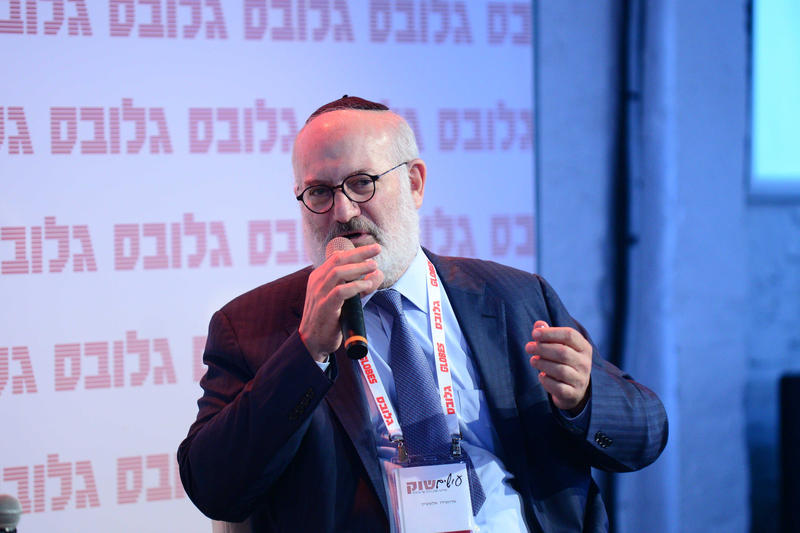
Argentina's largest real estate developer, president of Chabad Argentina, president of Hillel Argentina and president of Taglit Birthright Argentina, Eduardo Elsztain turns 66…
Pioneering computer scientist, Barbara Bluestein Simons, Ph.D., turns 85… Singer-songwriter, socialite and political fundraiser, Denise Eisenberg Rich turns 82… Economic and social theorist, author of 23 books, Jeremy Rifkin turns 81… New Haven, Conn.-based personal injury attorney, Herbert Ira Mendelsohn… Publishing professional, Agnes F. Holland… Professor emeritus of modern Judaic studies at the University of Virginia, Peter W. Ochs turns 76… Two-time Emmy Award-winning film and television director, her 2018 film is a biographical legal drama based on the life of Justice Ruth Bader Ginsburg, Mimi Leder turns 74… President of The Foundation for Ethnic Understanding, Rabbi Marc Schneier turns 67… Senior rabbi of Manhattan's Stephen Wise Free Synagogue, Ammiel Hirsch turns 67… Co-founder of the Laura and Gary Lauder Family Venture Philanthropy Fund, Laura Heller Lauder… President of HSK Consulting, focused on
strategic planning and fundraising services, Hilary Smith Kapner… Former CNN anchor and correspondent for 12 years, author of two books, she runs a website and newsletter focused on uplifting and positive news, Daryn Kagan turns 63… Co-founder of Boardroom One, Brent Cohen… Actress, comedian and television screenwriter, Claudia Lonow turns 63… Chief of the general staff of the IDF, previously director-general of the Ministry of Defense, Eyal Zamir turns 60… Senior strategist and consultant at Hillel of Broward and Palm Beach, Fla., Jill Weinstock Deutch… Oakland County (Mich.) clerk and register of deeds, she served on the board of the Jewish Association for Residential Care, Lisa Brown turns 59... Inaugural director of the Pava Center for Women’s Torah Scholarship at Yeshiva University, Raizi Chechik… Former middleweight boxing champion, he retired in 2003 with a 37–1–1 record, now a credit union loan officer, Dana Rosenblatt turns 54… Retired tennis player who was the top-ranked player in his age group at the ages of 12, 14, 16 and 18, then as an adult he won 15 doubles championships, Justin Gimelstob turns 49… Actress, she hosted The CW reality series “Shedding for the Wedding,” Sara Rue (born Sara Schlackman) turns 47… Policy director and counsel at Morrison Cohen LLP, he was previously an Obama White House Jewish liaison, Jarrod Neal Bernstein turns 46… Senior advisor at the Harold Grinspoon Foundation and president of the Palm Collective, Tamar Remz… Former Olympic figure skater, now in business operations at Figma, Emily Hughes turns 37… Blues and jazz musician, he describes himself as “sporadically shomer Shabbos,” Jerron "Blind Boy" Paxton turns 37… Member of the Rhode Island House of Representatives from 2015-2019, Jonathan Aaron Regunberg turns 36… Co-founder and CEO of Bardin, Fay Goldstein...
|
|
|
|


_01KFX9XEXF41CRRZ44XDXFW2DC.png)