Good Wednesday morning!
In today’s edition of Your Daily Phil, we examine the expected legal battle regarding a
state-funded Jewish charter school in Oklahoma. We report on an $18 million endowment that was donated to Brandeis University for its chemistry department by a former professor, and on the latest $300 million allocation for the federal
Nonprofit Security Grant Program, which Jewish groups consider to be far too little in light of growing threats. We feature an opinion piece by
Dan Osborn about how Jewish identity and history are approached in non-Jewish school classrooms, with specific focus on the long and rich history of Jews in Iran, and
Rabbi David Baum responds to a recent op-ed on problems along the rabbinic pipeline. Also in this issue: Sarit Silverman,
Noam Bettan and Daniel Segal.
Spread the word! Invite your friends to sign up.👇 |
|
| - President Donald Trump will speak at the World Economic Forum in Davos, Switzerland, this afternoon local time after a delayed arrival resulting from an electrical issue on Air Force One that forced the initial plane to return to Joint Base Andrews after an hour in flight to be swapped out.
-
Canada’s Azrieli Foundation is reshuffling its leadership, appointing André Beaulieu as CEO, succeeding Naomi Azrieli, who will continue to serve as board chair in an “expanded and newly designed role.”
|
|
|
A QUICK WORD WITH EJP'S JUDAH ARI GROSS |
There’s a Supreme Court case brewing in Oklahoma, and the heads of the local Jewish community are annoyed to find themselves thrust into the middle of it.
In November, the National Ben Gamla Jewish Charter School Foundation submitted a letter of intent to establish a virtual charter high school in the state, and last week, the organization took its application to the state’s charter school board for approval. For Oklahoma’s relatively small Jewish community — comprising less than 9,000 people, according to the latest estimates, mainly in Tulsa and Oklahoma City — the Ben Gamla application came out of the blue and puts it in the uncomfortable situation of being on the front lines for a likely divisive legal battle on one of the most sensitive topics in American politics: the separation of church
(or in this case Jewish day school) and state. The case appears to be following the same path as a Catholic charter school, St. Isidore, which sought to open in the state but was stymied by a split 4-4 U.S. Supreme Court ruling last year.
“It came on our radar about a month ago, when it came on everybody's radar. We found out through the press that they had submitted this application,” Joe Roberts, executive director of the Tulsa Jewish Federation, told eJewishPhilanthropy. (Disclosure: eJP Managing Editor Judah Ari Gross is one of the federation’s Elson Israel Fellows.)
“I have concerns about our community being affected by this. It is going to become a national issue, and this is politicizing a Jewish community that had no input in the process and has no say in the outcome if we're not consulted. That's a concern to me,” Roberts said. “Why are they doing it in our name?”
Eric Baxter, an attorney representing Ben Gamla, told eJP that the group had spoken with families in the state and that it was acting out of a belief that “families in the Sooner State deserve more high-quality educational options for their children.” He added: “Though it is still early in the process, Ben Gamla has already received interest from multiple families in the state."
The charter high school that Ben Gamla seeks to open in Oklahoma is explicitly Jewish, integrating “general academic excellence with Jewish religious learning and ethical development,” according to its application. In seeking state support for a religious charter school, the Ben Gamla foundation is widely understood to be teeing up a legal battle that is expected to wind its way through the state courts and to the Supreme Court.
While topics like Israel and Zionism more frequently serve as sources of tension and division within the Jewish community, the issue of state funding for Jewish day schools also splits the American Jewish community. For the Orthodox world, which is far more likely to send children to Jewish day schools, the high tuition fees are a major hurdle and a constant source of communal frustration. This is less of a practical issue for non-Orthodox Jews, for whom a clear separation between religion and state is the more pressing matter.
And indeed, while some of the signatories on the Tulsa Jewish community’s statement against the school have raised specific issues with the proposal related to a state-funded religious charter school, for Roberts, that is a moot point. “I'm not saying that we want it or don't want it. I think our position is that this decision should not be made without consulting the local community about its needs and how it will affect it,” he said.
Read the rest of ‘What You Should Know’ here. |
|
|
Former professor brings chemistry ‘renaissance’ to Brandeis with $18M endowment |
When Arthur Levine studied science at Brandeis University during the late 1960s, professor Peter Jordan was a legend. “He was the chemistry department,” Levine, now the school’s president, told eJewishPhilanthropy’s Jay Deitcher. A half-century later, Jordan continues to pave the way for a bright future for the department. On Friday, Jordan, who retired in 2011 as professor emeritus, and his wife, Barbara Palmer, announced an $18 million endowment to support research in theoretical and physical chemistry at the school. The donation honors Jordan’s father, Hans Jordan, who fled the Nazis and designed
one of the first reliable garbage disposals.
Chemistry’s set: The $18 million endowment will create nearly $1 million in funding annually for the school indefinitely. That allows the school to hire two new positions — a senior professorship in theoretical chemistry and a junior professorship in physical chemistry — and to create three new graduate research fellowships in the chemistry department, as well as provide additional funding for research. “What this gift did is create a renaissance,” Levine said. “It’ll bring more faculty to the department. Brandeis can use these new chairs to recruit the world’s ablest and most promising chemists. We can also use it to attract the best chemistry students in the world.”
Read the full report here. |
|
|
Congress allocating $300 million for nonprofit security grants in 2026 |
With worshippers at Beth Israel Congregation in Jackson, Miss., still reeling from a Jan. 10 arson attack that severely damaged the historic synagogue, Congress appears poised to provide $300 million for the Nonprofit Security Grant Program for 2026, a small boost from the funding provided in 2024 and 2025. But that figure is lower than the allocations initially proposed by both the House and Senate, even as antisemitic events, such as the arson in Jackson, continue to rock the Jewish community. And it is significantly less than the target level of $500 million to $1 billion for the program requested by congressional advocates and Jewish groups, reports Marc Rod for
eJewishPhilanthropy’s sister publication Jewish Insider.
Stuck in the middle: The funding, part of the Homeland Security budget, may also suffer from additional friction amid Democratic opposition to the package, linked to concerns about Immigration and Customs Enforcement operations throughout the country. It is not yet guaranteed that the package will actually pass, with key Democrats, including Sen. Chris Murphy (D-CT), the ranking member of the Senate Appropriations Committee’s Homeland Security Subcommittee, announcing their opposition to the bill.
Read the full report here and sign up for Jewish Insider’s Daily Kickoff here. |
|
|
Teaching about Iranian Jews today |
“Whenever I talk to teachers in public schools or non-Jewish independent schools about Iran and Jews, most assume the conversation will invariably go in the direction of Iranian-Israeli relations. They expect my spiel will be about geopolitics; they tend to be taken aback when I instead direct the conversation towards the 2,700 years of Jewish life in Iran,” writes Dan Osborn, executive director of Project Mosaics, in an opinion piece for eJewishPhilanthropy. “[W]hen there is so much contention about who Jews are, studying Jews from Iran — and elsewhere around the world, for that matter — is fundamental to helping students of all backgrounds appreciate the geographic, linguistic, ethnic and cultural
diversity of Jewish people.”
Join today’s conversation: “As Iran undergoes this current wave of popular unrest, American classrooms are the very spaces best designed for making sense of this dynamic situation. Students who know very little about Iran need to listen to Iranians. Encountering the perspectives of Iranian Jews can be but one very powerful catalyst in raising questions, provoking inquiry and cultivating meaningful and timely learning. And as American Jews wrestle with questions of Jewish representations in history curricula, the case study of Jews in Iran is one example of all the ways Jews can be represented beyond the familiar formulas.”
Read the full piece here. |
|
|
The rabbinate isn’t in crisis because of text — it’s about leadership |
“I deeply respect Rabbi Daniel Landes and the seriousness with which he approaches the future of the rabbinate through his organization, Yashrut. His recent opinion piece (‘For tomorrow’s rabbinate, we must up our game,’ eJewishPhilanthropy, Jan. 12) reflects a genuine concern for the spiritual and intellectual vitality of Jewish leadership,” writes Rabbi David Baum of Congregation Shaarei Kodesh in Boca Raton, Fla., in an opinion piece for eJewishPhilanthropy.
A different take: “[M]y perspective comes from 16 years in the field, serving a single congregation through profound change. That difference in vantage point may explain why I arrive at a different conclusion, and why I offer the following critique with both respect and urgency. … Rabbis are not failing because they lack intellectual seriousness or textual depth. They are struggling because they are being asked to lead complex, anxious, polarized communities without having been trained in adaptive leadership, organizational management, conflict navigation, governance, fundraising or relational resilience. In other words, they are being trained for a world that no longer exists, and then sent into one that barely resembles anything their teachers experienced.”
Read the full piece here. |
|
|
Call for Change: In The Times of Israel, Sarit Silverman echoes the widespread alarm over the death of two babies and the hospitalization of more than 50 other babies and toddlers rescued from a Jerusalem day care center. “It is a horrible tragedy. A tragedy compounded by people blaming the families’ lifestyle and politicians blaming their opponents.
What we all can, and should, agree on is this: every single child in the State of Israel, regardless of age or family background, should be safe in their educational institution. Yet early childhood education has been neglected for far too long. As a country that values growing families, we do not invest enough in the systems that ensure our youngest citizens receive basic safety and care.” [TOI]
Zachor: In The Jerusalem Post, William Daroff writes about Oct. 7 deniers in the context of International Holocaust Remembrance Day, which is Jan. 27. “This pattern should unsettle anyone who claims fidelity to the lessons of Holocaust history. The Holocaust did not begin with gas chambers. It began with disbelief, euphemism, and the failure of institutions to confront reality as it unfolded. Today, the facts of Auschwitz stand beyond dispute. That clarity came only after catastrophic loss. We should not require decades, archives, and posthumous apologies before moral clarity emerges again. … In response to the denial and distortion surrounding that day, an independent body of legal scholars, human rights experts, forensic
specialists, and trauma professionals established the Civil Commission on October 7th Crimes Against Women and Children. Its mandate is not political. It is evidentiary. The commission exists to document crimes, preserve testimony, and ensure that these atrocities are neither forgotten nor denied. This effort matters not because it competes with other suffering, but because truth does not fragment.” [JPost]
Truth in Art: In the Washington Jewish Week, Lisa Traiger spotlights the work of Ann McElhinney and Phelim McAleer, two Catholic Irish-American journalists, to bring personal testimonies from the Oct. 7 attacks to the stage, first in New York City and next week in Washington. “The husband-and-wife journalistic team, founders of The Unreported Story Society, have committed themselves to shedding light on important breaking news events that have often been ignored by mainstream media through theatrical dramatization. … This verbatim theater technique uses transcripts of trials, interviews and testimony to create narrative plays that are ripped from the headlines. … Most recently
McElhinney and McAleer have applied this theater vérité technique to the Oct. 7 attack. The result: ‘October 7,’ a verbatim play culling from more than 100 hours of interviews the reporters conducted with survivors of the massacre during a visit to Israel just two weeks after the attack.” [WashingtonJewishWeek]
|
|
|
Do you want to transform your leadership and build a community with other Jewish professionals? Apply to Spertus Institute’s Certificate in Jewish Leadership, offered in partnership with Northwestern University, to develop new skills while deepening your Jewish professional network. Apply for the upcoming cohort here.
|
Be featured: Email us to sponsor content with the eJP readership of your upcoming event, job opening or other communication. |
|
|
The Chronicle of Philanthropy dives into the issue of staff turnover at nonprofits, which remains high despite a job market that should be encouraging workers to stay…
The Supreme Court declined to hear a case brought forth by Agudas Chasidei Chabad, a Brooklyn-based umbrella group representing the Chabad-Lubavitch movement, against Russia over the return of sacred Jewish texts that had been taken by the Nazis and are now held in Russia…
The Associated Press spotlights the philanthropy-backed “Be The People” campaign, which is being rolled out ahead of the United States’ 250th anniversary and encourages Americans to volunteer…
Antisemitic graffiti was spray-painted on Charlotte, N.C.’s Shalom Park, a campus in the city that houses multiple synagogues, the local Jewish federation, a Jewish Community Center, Jewish school and other local Jewish institutions…
Israeli singer Noam Bettan won the season finale of popular Israeli singing competition show “Rising Star,” becoming Israel’s entrant to the 2026 Eurovision Song Contest…
Israel began demolishing the east Jerusalem headquarters of the U.N. Relief and Works Agency, following the passage of a law banning the agency, which works with Palestinians, over what Israel says is its support for terrorism and staffers’ ties to terror groups; the move has drawn swift criticism from the United Nations…
Argentina’s Sephardic chief rabbi renewed a 100-year-old halachic ruling barring conversions from being completed in the South American country, requiring them to be carried out in Israel; the country’s non-Orthodox communities decried the ruling, which they see as discriminatory and anachronistic… Bloomberg reports that telecom magnate Patrick Drahi is preparing to sell his controlling stake in the French fiber optic company XpFibre, in a move that could net him billions…
Philadelphia attorney Daniel Segal, who helped represent thousands of children who were illegally incarcerated by judges who received kickbacks from for-profit detention facilities and who advocated for the release of Soviet Jewry, died on Jan. 8 at 79…
Dr. Lawrence Gelman, a Texas-based Jewish anaesthesiologist and philanthropist best known for his collection of stained glass windows from churches, died this week…
Literary agent and Holocaust survivor Georges Borchardt, who found a publisher for Elie Wiesel’s Night and represented the estates of such writers as Tennessee Williams and Hannah Arendt, died on Sunday at 97… |
|
|
Jeffrey M. Solomon, vice chair of TD Bank U.S. and former chair and CEO of Cowen, (not to be confused with Jeffrey R. Solomon of Chasbro Investments), began his tenure as chair of the board of the Foundation for Jewish Camp; Solomon succeeds Jim Heeger who has served in the role since 2016…
Jennifer Stone is joining the Dorot Foundation as its next project director…
Larry Gast is leaving the Jewish Federation of St. Louis, where he has served as vice president of development, and will return to the American Jewish Joint Distribution Committee, where he previously worked… |
|
|
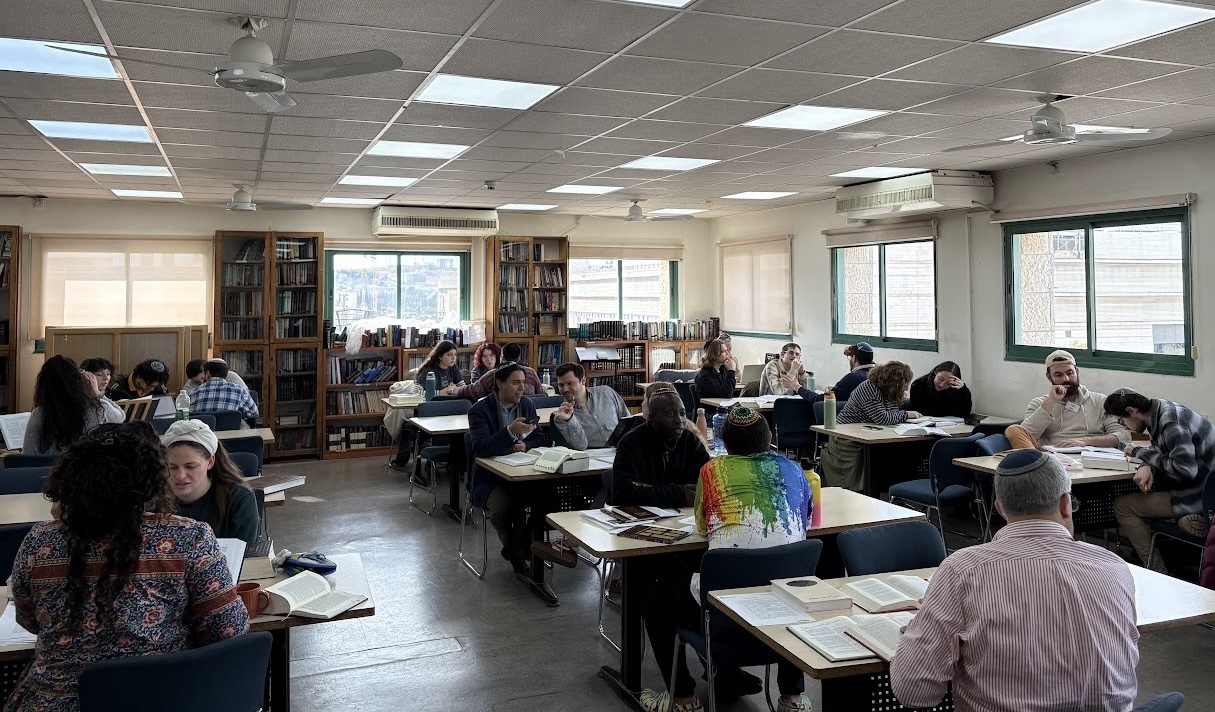
Students are seen studying in the Pardes Institute of Jewish Studies’s beit midrash today. Twenty-seven new students belatedly joined Pardes’ yearlong Beit Midrash Program, alongside the 75 students who began the program in September, which the institute’s president, Rabbi Leon Morris, told eJewishPhilanthropy is “indicative of ‘The Surge’” in Jewish engagement post-Oct. 7. |
|
|
President and CEO of The Harry and Jeanette Weinberg Foundation, Rachel Garbow Monroe…
Writer specializing in modern Judaism and women's issues, Blu Greenberg (born Bluma Genauer) turns 90… Philanthropist, co-founder and chair emerita of the Charles and Lynn Schusterman Family Philanthropies, Lynn Schusterman… Owner of the NHL's Boston Bruins and chairman of Delaware North, a global food service and hospitality company, Jeremy Maurice Jacobs turns 86… Literary critic, feminist, writer on cultural and social issues, Elaine Showalter (born Elaine Cottler) turns 85… Retired Israeli ambassador to Cyprus, New Zealand, Turkmenistan and Estonia, Shemi Tzur turns 81… Israeli visual artist, he taught at Jerusalem's Bezalel Academy of Arts for 30 years, Zvi Goldstein turns 79… Actor, director and producer, he is the voice of Beast in Disney's “Beauty and the Beast,” Robby Benson (born as Robin David Segal) turns 70… Past chairman of the Zionist Organization of America and chair of the real estate group at the NY/NJ law firm of Sills Cummis & Gross, Mark Levenson turns 69… CEO of UJA-Federation of New York since 2014, he will retire in June, Eric S. Goldstein turns 66… Chairman and CEO of Norfolk, Va.-based Harbor Group International, a $21 billion real estate investment firm, Jordan E. Slone turns 64… Executive editor digital at the Washington Monthly, Matthew Cooper… Chief operating officer of OneTable, Andrea Greenblatt… Senior fellow at the USC Annenberg School, she is the former editor-in-chief of both Glamour and Self magazines, Cindi Leive turns 59… CEO at C-SPAN, Sam Feist turns 57… Director, producer and screenwriter of films, best
known as the producer or director of the eight films in the "Paranormal Activity" series, Oren Peli turns 56… Christian Zionist, television host and presenter of “The Watchman” sponsored by Christians United for Israel, Erick Stakelbeck turns 50… CEO at Shpait.AI, Shlomo Einhorn… Peruvian model and TV host, she represented her country in Miss Universe 2009, Karen Schwarz turns 45… Washington-based staff writer for the Los Angeles Times, Jennifer Haberkorn… Israeli actress, screenwriter and filmmaker, Romi Aboulafia turns 42… Vice president, chief of staff and senior counsel at Children's National Hospital, Jordan Grossman… Samuel Z. Eckstein...
|
|
|
|